Message from the Director
When I think about where my journey began, it wasn’t in a boardroom, a lecture hall, or on one of my weekend hikes. My story doesn’t just begin with me; it begins with my family, my ancestry, my culture, and the lived experiences that shaped who I am today.
As a second-generation Canadian and the child of immigrant parents from Punjab, I grew up hearing stories of the fields that once fed our family for generations. For my parents, agriculture was more than a livelihood, it was a symbol of our shared heritage and our responsibility to care for the planet and the life it sustains.
As I grew older, I began to understand the fears and struggles faced by families in Punjab as climate change disrupted rainfall patterns, reduced crop yields, and filled the air and soil with toxins. I came to see that its impacts weren’t only physical, but deeply emotional. The anxiety, grief, and helplessness of watching your land change faster than you could adapt, a weight far too heavy for any one person to carry alone.
For far too long, there have been no safe spaces to talk about the emotional toll of climate change on ourselves, our families, or our communities. In my own village, I saw the uncles and aunts who once took pride in their harvests now burdened by debt they couldn’t repay. Farmer suicide has become a devestating reality around the world, including here in Canada, and it reflects the mental health crises that arises when those most affected by climate change are left without tools, support, or spaces to process their eco-grief. That silence stayed with me.
I carried these stories with me, from my elementary school classrooms in Peel to my lecture halls at McMaster University. On campus, I became deeply involved in sustainability initiatives, connecting students to advocacy resources, expanding access to carbon-neutral materials for marginalized youth, and helping build a more inclusive, environmentally conscious community. My research at CAMH, Canada’s largest mental health teaching hospital, also revealed the quiet weight many people carry in silence. Yet, something still felt missing, as though I had only begun to scratch the surface of the work ahead.
Over time, I began to see the pattern. I was advocating for a healthier planet and for healthier people, but rarely acknowledging how the two were connected. For years, it felt like I was living between two worlds, one focused on sustainability, the other on emotional well-being, until I realized they were never separate at all. Climate change isn’t just an environmental crisis; it’s a mental health crisis too.
That realization showed me the quiet power of conversation, of naming what climate change feels like, not just what it measures. For too long, we’ve shared data but not emotions, staying silent about the fear, grief, and hope beneath the numbers. The worry, guilt, and exhaustion many young people carry have never had a name, let alone a space. Real change begins when we listen to one another, when we give language to what’s heavy, and remember that none of us carry this alone. Climate communication isn’t just about sharing information, it’s about building empathy, connection, and the courage to act.
This understanding led me to Green Mind, a community where conversations about climate anxiety are met with compassion, not judgment. Here, we create safe spaces for those most affected to feel supported in their worries and understood in their grief. My vision is to empower the next generation of marginalized youth with the tools and resources to live sustainably, build eco-resilience, and know that it’s okay not to feel okay. By accepting our emotions instead of resisting them, we give ourselves room to process, understand, and grow, realizing that our feelings are part of us, but they don’t define us.
Through creative arts-based workshops held across the country, we’ve seen how expression can help release fear and transform it into healing. Our national projects, including bilingual toolkits, empower young people to learn from Indigenous elders about honouring and connecting with the land through mindfulness, somatic grounding, and traditional stewardship practices.
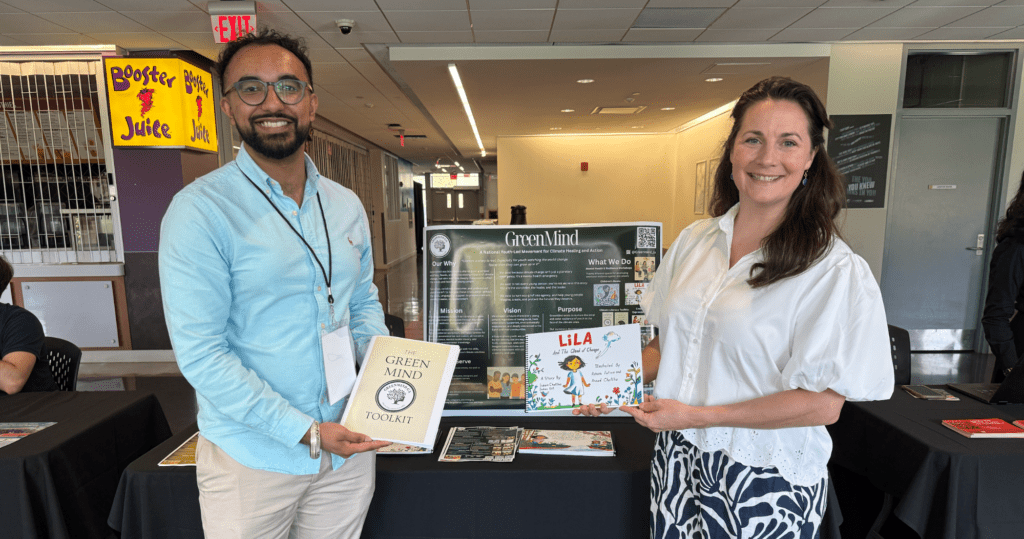
More recently, our children’s books, including Lila and the Cloud of Change and Noura’s Jar of Worries, share stories of young people displaced by climate change. They serve as gentle reminders that every action, no matter how small, has the power to create change. Beyond inspiring action, we remind children that they are our hope, our future, and the reason we must keep building a better world. Through our workshops in schools, camps, and community programs, we help children understand that feeling overwhelmed is okay, that their care for the planet is a reflection of courage, not weakness. Watching their confidence grow as they realize their voices and ideas matter has been one of the most rewarding parts of this journey. It reminds me that hope isn’t something we find; it’s something we nurture in others. One story, one conversation, and one child at a time.
Personal Note:
At its heart, this work has always been about belonging by creating spaces where young people across the country feel safe, valued, and seen for who they are and the stories they carry. Our mission is to build a platform that honours every identity, validates every feeling, and celebrates vulnerability as a source of strength. To care deeply, to feel fully, and to act courageously are what make us human. We may each hold our own hopes and fears, but our shared love for the land, the water, and the sky connects us in ways words cannot.
From Punjab to the Prairies, I’ve met young people who carry the same quiet questions about their future, their communities, and the planet they will inherit. Many have been told to stay strong and hide their emotions, but true strength lies in acknowledging what we feel and finding support in one another. When we create spaces to share our worries, we transform them into opportunities for healing and change. By honouring our emotions, we reclaim our power, build community, and remind ourselves that sorrow doesn’t need to be silenced, it can be shared in the name of hope.
What I want every young person to know is this: your feelings don’t need to be ignored or “fixed,” because you are not broken. You deserve to feel safe trusting others, learning about our planet, and creating real change in your communities. Caring is not a weakness, it’s a form of strength. It means you see value beyond what the eyes can measure, something that can only be felt. To feel is to care, and to care is powerful, because caring is how change begins.
When we stop hiding our worries and start sharing them, we find connection. We find possibilities. We turn fear into hope, and hope into action. And in doing so, we remind ourselves that even in a world of uncertainty, there is always something worth building, protecting, and worth believing in, together.
With my deepest gratitude and respect,
Jashan Gill
Director of Operations
Green Mind Canada